
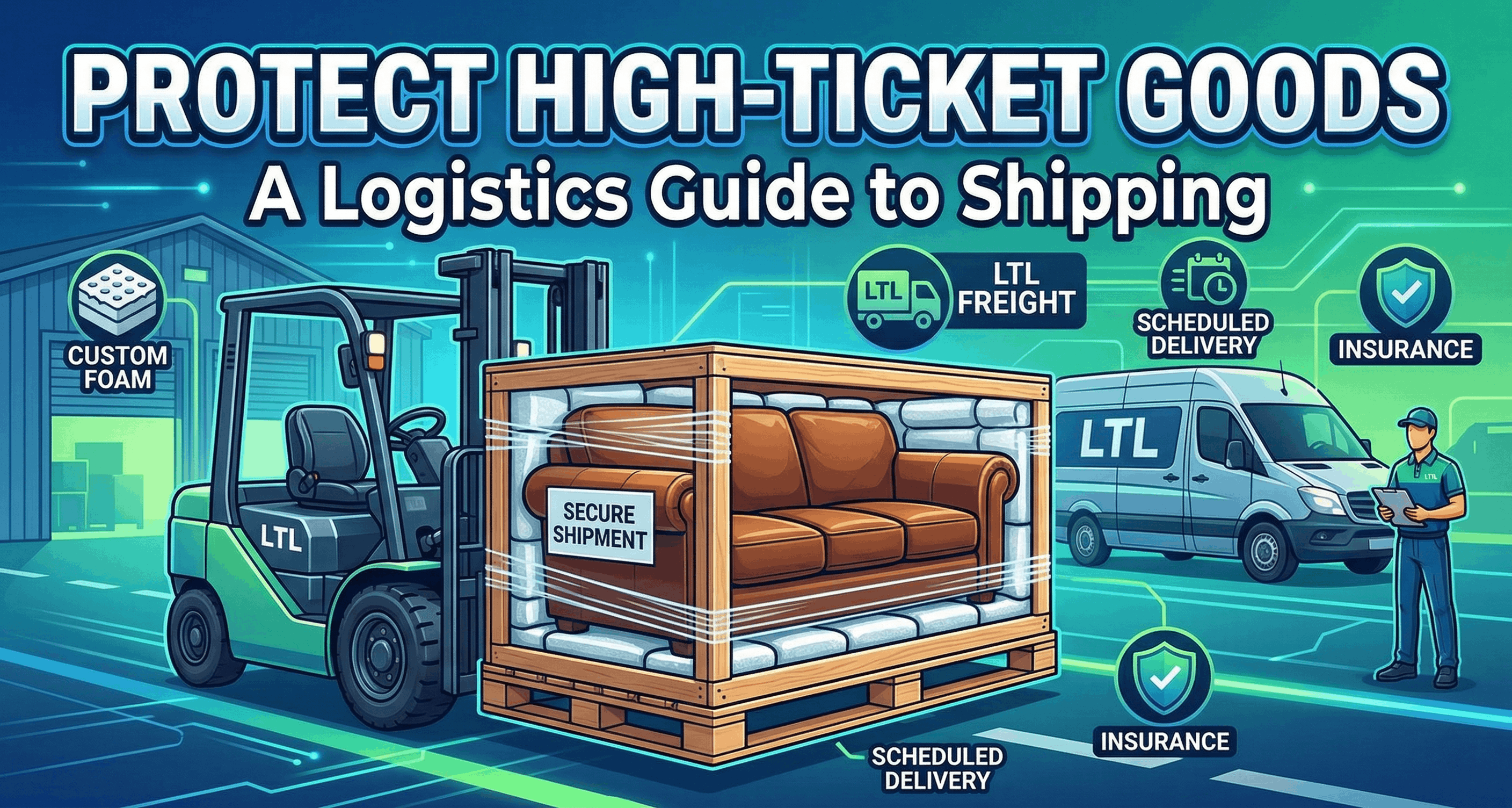
How to Protect High-Ticket Items When Shipping (A Logistics Guide)
Learn how to protect high-ticket items when shipping. Discover the packaging, insurance, and delivery calendar strategies used by top furniture brands.
When a mid-sized British furniture retailer audited their quarterly logistics data in 2024, the executives made a horrifying discovery. Replacing and reshipping damaged dining tables was completely wiping out the profit margin of their entire dining category. They were effectively paying customers to take their flagship products.
If you sell $50 t-shirts, a damaged-in-transit claim is a nuisance. You click "refund," write off the manufacturing cost, and move on.
But if you are shipping a $3,000 custom-upholstered corner sofa or a heavy concrete bathtub, damage does not just mean losing the cost of goods sold. You have to pay exorbitant return freight to retrieve the broken item. You have to pay out-of-pocket to manufacture a replacement. You have to pay freight a third time to ship the new item. And the customer, furious about the multi-week delay, probably leaves a one-star review anyway.
If you are wondering how to protect high-ticket items when shipping, you cannot rely on bubble wrap and "Fragile" stickers. You need a comprehensive operational strategy that encompasses packaging, courier selection, and strict delivery coordination.
Quick Takeaways:
The "Box-in-Box" Method: Heavy goods require structural integrity. Never ship high-value items in single-walled cardboard.
Courier Selection: Standard parcel couriers drop packages. For heavy items, you must use LTL (Less-Than-Truckload) or specialized two-man delivery teams.
Delivery Coordination: Unattended packages get stolen or ruined by weather. Force customers to pick a specific delivery date so they are physically present to receive the goods.
Step 1: Structural Packaging Standards
When shipping items valued over $500, the packaging must be designed for structural survival, not just aesthetics. A 50-kilogram media console acts like a wrecking ball inside a cardboard box if it is not properly restrained.
The Double-Boxing Protocol
For items that can physically fit inside standard boxes (like heavy lamps or appliance parts), use the double-boxing method. Place the item in its original, smaller box, heavily cushioned with custom-cut foam. Place that box inside a larger, heavier-duty corrugated box, leaving at least two inches of space on all sides to be filled with dense cushioning materials.
Custom-Cut Foam Constraints
Never use packing peanuts or standard bubble wrap for heavy items. Under the weight of a 40kg object, bubble wrap pops and peanuts disintegrate into dust during transit vibrations. Utilize rigid, custom-cut foam inserts that perfectly mold to the item, holding awkwardly shaped, delicate items firmly in place so they cannot build momentum inside the crate.
Tamper-Evident Tape
Theft is a primary concern for high-ticket items. Use tamper-evident tape to seal all seams using the H-taping method. If a courier or thief attempts to slice the box open and reseal it, the tape will aggressively display a "VOID" pattern, allowing the customer to instantly reject the delivery upon inspection.
Step 2: Strategic Courier Selection
No amount of packaging will save a fragile, heavy item if it is handed to a courier network designed for volume rather than care.
Avoid the Standard Parcel Network
Standard couriers (like standard FedEx Ground, UPS, or Hermes) rely on automated conveyor belts and single-driver delivery vans. A single driver physically cannot lift a 70kg boxed bed frame without dropping it or dragging it across the pavement. If your item exceeds 30kg, it does not belong in the standard parcel network.
Invest in LTL and White-Glove
For heavy goods, you must utilize LTL (Less-Than-Truckload) freight shipping or specialized two-man "white-glove" delivery services. These networks use palletized transport, meaning forklifts move the goods rather than humans dropping them. White-glove services guarantee two people arrive at the customer's home to carry the item carefully into the room of choice. While this costs significantly more upfront, it is drastically cheaper than paying for reverse logistics on a shattered dining table.
Step 3: Enforcing Delivery Coordination (The Calendar)
The most robust packaging and the best white-glove courier become useless if the truck arrives at an empty house.
If a two-man delivery team leaves a $2,000 sofa on a driveway because the homeowner is at work, that item is instantly vulnerable to weather and theft. If the driver decides to take it back to the depot, it faces another round of handling, increasing the risk of damage, and you get hit with a redelivery fee.
The Solution: You must force the customer to coordinate the drop-off.
Do not wait until the item leaves the warehouse to try and arrange a time. Using a dedicated delivery date app (like Flare) integrated directly into your Shopify checkout, require the customer to pick their delivery date before they can hand over their credit card.
By utilizing product-level lead times, the calendar will automatically push the available dates weeks into the future if the item is made-to-order. The customer selects a Tuesday, they lock that Tuesday in their personal calendar, and they are guaranteed to be home when the truck arrives. This guarantees the item goes straight from the truck into the living room, eliminating driveway exposure and handling damage.
Step 4: Comprehensive Insurance and Documentation
Even with perfect operations, accidents happen on the highway. You must financially insulate your business against total loss.
Declare Full Value
Carrier liability is almost always capped by weight (e.g., $0.50 per pound). If your 50-pound chair is worth $1,500, the courier's default liability will only pay you $25 if they run it over with a forklift. Always purchase supplemental full-value insurance through the carrier or a third-party application like Route or ShipSurance.
Document the Outbound Condition
When shipping high-value bespoke items, take photographic or video evidence of the item before it goes into the crate, and another photo of the sealed crate on the pallet. This eliminates the carrier's ability to claim the item was "insufficiently packed" when you file a damage claim.
Mandate Signature on Delivery
Never allow a high-ticket item to be left unattended. Instruct your courier that a signature is mandatory. Furthermore, explicitly instruct your customers via automated confirmation emails to inspect the exterior of the box before signing the slip. If the box is crushed, they must note "received damaged" on the driver's electronic pad; otherwise, the courier will deny your insurance claim.
The Bottom Line
Figuring out how to protect high-ticket items when shipping requires you to stop thinking like a retailer and start thinking like a logistics director. It requires upfront investment in premium foam, LTL freight networks, and checkout calendar technology.
While the finance department might complain about the upfront cost of white-glove shipping and Shopify checkout extensions, compare that cost against your historical refund and reverse-logistics data. A perfect delivery experience protects your margins, secures five-star reviews, and ensures your heavy goods business can scale without collapsing under the weight of shipping claims.
Frequently Asked Questions (FAQ)
What is the best way to package a very heavy, fragile item?
Use the double-boxing method with rigid, custom-cut foam inserts rather than bubble wrap. The item must be completely immobilized within the inner box, and the inner box must be suspended within the outer box.
Should I use standard couriers for items over 30kg?
No. Items over 30kg generally require two people to lift safely. Putting heavy goods through a standard parcel conveyor-belt network almost guarantees they will be dropped. Use LTL freight or specialized two-man delivery services.
How do I stop couriers from leaving high-ticket items on the driveway?
Implement two rules: mandate a signature upon delivery with the courier, and force the customer to pick a specific delivery date during the Shopify checkout process using a calendar app. If the customer chooses the date, they will be home to receive it.
Do I need to buy extra insurance for heavy freight?
Yes. Freight carrier liability is usually calculated by weight, which severely under-compensates high-ticket, lightweight items. Always purchase third-party or declared-value insurance to cover the full retail cost of the goods.
Can I pass the cost of white-glove delivery to the customer?
Absolutely. Customers buying premium furniture or heavy goods expect premium shipping options. In fact, many high-end brands find that customers prefer to pay an extra $150 for "White Glove Room of Choice" delivery rather than struggling to move a 100kg box themselves.